 {{ ctaEmail }}
Membraine · System of Intelligence
When did we stop being one platform?
Nobody decided to abandon it. It eroded across eight months of individually-correct decisions, each made by people who could not see the others. By the July QBR the question was on the table and nobody in the room could answer it.
Membraine names the day.
Three views of one program: where the tension sits, which requirements collide, and how both grew across eight months. Watch the full two minutes →

Every screen shows the running product. The program is Project Lattice at Meridian Payments Network — a fictional payments company, so nothing here is any client’s confidential record.
01 · The problem
Everyone owns the nodes. Nobody owns the edges.
Every layer of intent in a large enterprise has a well-funded owner.
Each of these owns a node. None of them owns the edge — the because that justifies one node in terms of another.
“We relaxed that requirement because of this steering decision.”
Your teams say those sentences out loud in meetings and write them down nowhere. They are the first thing an auditor, a new program lead, or an AI agent asks for.
02 · What it is
Where Membraine sits in your stack
Your organization has excellent records of what it decided and almost none of why. Membraine captures that reasoning as it happens and holds it as structured, typed, time-stamped links between the things you already track — a lineage of intent running from strategic objective to requirement to the moment it was decided. Because those links are stored with time on two axes, Membraine can do something no document store can: tell you when two of them stopped agreeing, and replay what the organization believed on any past date.
Membraine adds a layer. It does not ask you to move anything into it.
We will never ask you to replace Jira, Confluence, or your OKR tool. They stay authoritative. Membraine reads across them, links them, and tells you when the picture stops being coherent.
03 · Mechanic one — the Golden Thread
From a 2030 bet to the sentence it was spoken in.
Membraine holds typed, directional links between the artifacts of intent — implements derives_from validates supersedes depends_on contributes_to breaks_down realizes — and records who proposed each one, with what confidence, and whether a person accepted it. AI proposes links; it never accepts them. Unlinking expires a link rather than deleting it, so your audit trail survives every revision.

Start at the portfolio: every objective, who owns it, how much work implements it, and how far it has drifted.

Open an objective to see the 49 requirements implementing it, the initiative delivering it, and Replay as of, which rewinds the thread to any date.

Open a requirement to see why it exists, what it must comply with, and where it came from.

Land on the meeting itself: the speaker, the timestamp, and the sentence as it was said.
Storage is not the value. These are the questions the links let you ask:
04 · Mechanic two — the Drift Radar
It does not just say these two conflict. It says when they started to.
The Radar raises two kinds of finding. A contradiction is two requirements serving the same objective that cannot both be satisfied; Claude compares them objective by objective, so the comparison stays meaningful rather than combinatorial. Staleness is a requirement whose ground has moved — its source document revised since extraction, or superseded but still linked. That check needs no model call, so it runs constantly.
Every finding is time-anchored.

Every one of those decisions was correct on the day it was made. That is what makes the drift so hard to see from inside it.

Open a blocker and both requirements sit side by side: Single Global Platform with Configuration-Only Regional Variation against Independent PCI-DSS Scoping and Assessment for EU Lattice Instance. Each side carries the objective it serves.
05 · As-of replay
Set the date to March and the flag is not there. Set it to April and it is.
Both time axes are preserved — when something was true in the world, and when you came to know it — so “what did the program believe on the day of that decision?” is a query, not a three-week archaeology exercise.

Now
49 requirements implement the objective.

Replay as of Mar 24, 2026
{{ replayN }} requirements — the rest had not been decided yet.
06 · The evidence
The shape of the problem, not a list of it.
Four views, each answering one question. Hover any mark to see what it collides with.


Sort every requirement by type and the pattern surfaces: 27 of 47 constraints contested against 12 of 35 functional. Your contradictions live in the constraints.
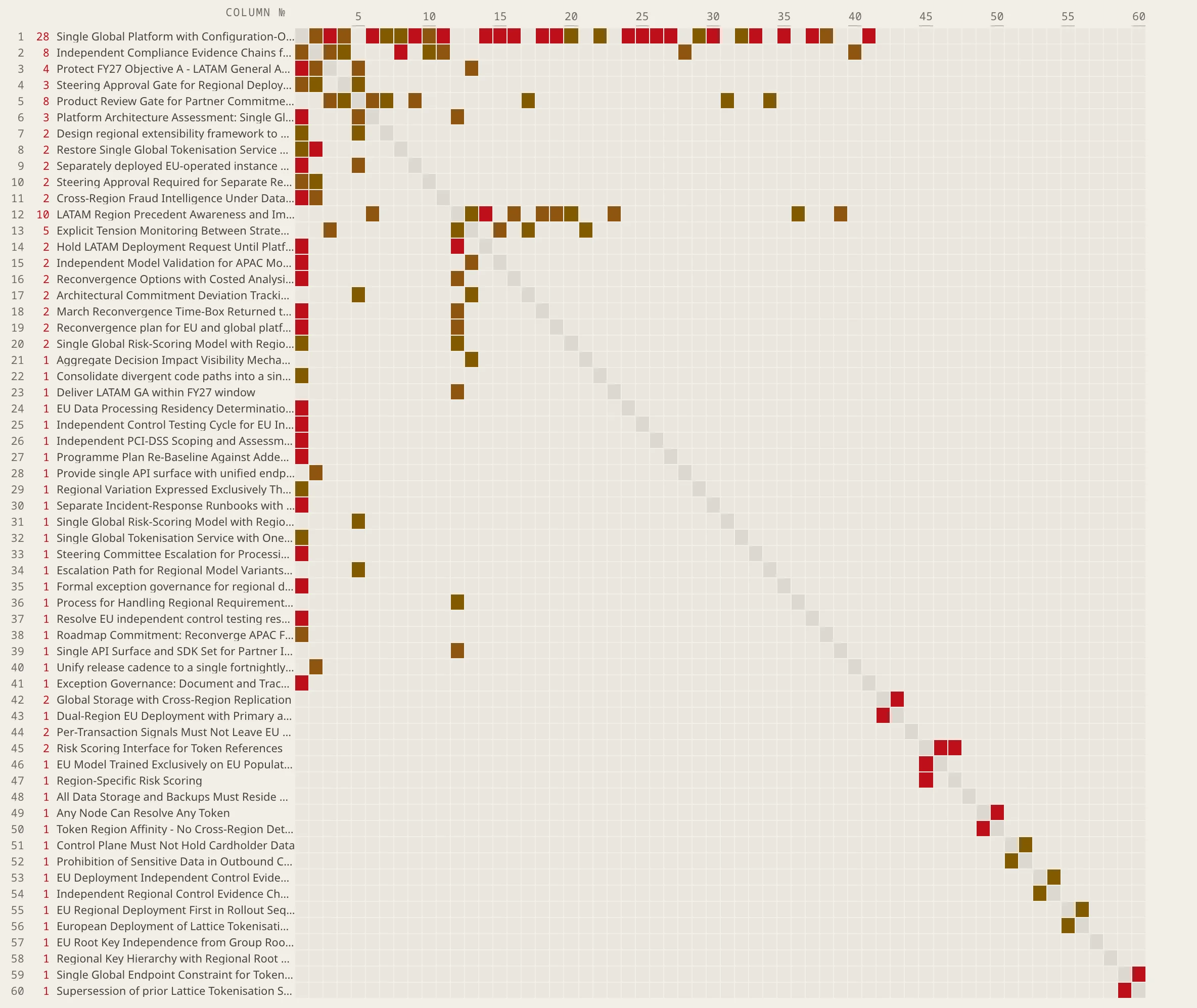

Sixty contested requirements, ordered so collisions sit together. A block on the diagonal is a cluster fighting itself; a long horizontal run is the one requirement everything else collides with.

Read the decision record as a sequence: every choice, the roads not taken beside it, and the real time that passed between sittings.


Three measures on one timeline. Requirements climb; conflicts climb faster. Hover a session to follow it across all three.
07 · Provenance
AI proposes. People accept.
Not autonomous, on purpose. AI proposes links, requirements and resolutions. Your people accept them. Every link records which is which. In a regulated environment, an auto-accepted edge is a liability, not a feature.

Everything waiting on a decision from your team.

A recommendation with its options, before anyone has picked one. The mark records that Claude proposed it, not a colleague.
08 · Why financial services
Why this lands hardest in financial services
Compliance cascade
Upload a compliance document at group, division or program level and Membraine — after showing you the blast radius and asking for confirmation — scans every requirement in every project beneath it for conflicts with the new obligation. The “new regulation lands on Friday, what does it break?” workflow, run in minutes rather than a quarter.
Four-tier document inheritance
Global → Client → Portfolio → Project, inheriting downward. A group-wide policy governs every program beneath it without being re-uploaded.
Regulation-aware extraction
Membraine extracts each requirement with its compliance constraints attached, named against the regime, with severity, section reference and verification method. You see the exposure at capture time, not at gate review.
GLBA · SOX · FFIEC · Basel III · PCI-DSS · GDPR · MAS TRM
As-of replay as an audit primitive
“Prove what we knew and believed on this date” becomes a query instead of a three-week exercise. With provenance on every link, that is your foundation for audit-grade traceability.

Ask which of your requirements fall under PCI DSS and read the answer: 12 of 134.
09 · White label
It wears your identity, not ours.
The same screen, the same data, the same minute — under two brands.
The mark changes. The accent changes. The call-to-action changes. So does the typeface — your brand book, not ours.

Membraine · house
Meridian · the client
Run it under your own identity and your teams see yours throughout.
What does not change is meaning. Your palette carries your identity; it never redefines what counts as a contradiction. Every combination is checked against WCAG AA for contrast.
10 · Where we are
Where the product stands today
What you can see today
Turn a transcript into structured requirements, each carrying the sentence it came from. Trace any requirement to the objective it serves and the meeting where it was decided. See contradictions as they appear, with the date each became observable, and replay any thread as of any date. Cascade a new obligation across every project beneath it. Hold decisions as records in their own right, and documents across four levels of scope.
What comes next
Connectors to Jira, Azure DevOps and Linear. The thread already reaches a delivery item; keeping it in step with your tracker is the next piece of work. After that, a signed audit export you can hand to a regulator, and precedent search across the history your own program builds up.
What we switch on for a pilot
Authentication is off in the demo. Enterprise OIDC is built, and we switch it on in week one.
Extraction takes two to four minutes per transcript, so we ingest ahead of a session rather than in front of the room.
11 · The pilot
What a partnership looks like
The ask
{{ ctaEmail }}Write to us and ask to see it on your own data — twelve weeks, your program, your transcripts.